A History of Leather
When I tell you I am a leatherworker, the first thing your mind might conjure is that signature, rich scent we call leather.
What if I told you that true leather is actually odorless? That iconic smell, the one that has become so recognizable, is actually a mix of dozens of chemicals and fragrances used to sell you a story, a story that in only a century has completely rewritten our relationship with the oldest textile on earth.
When I tell you I am a leatherworker, the first thing your mind might conjure is that signature, rich scent we call leather. What if I told you that true leather is actually odorless? That iconic smell, the one that has become so recognizable, is actually a mix of dozens of chemicals and fragrances used to sell you a story, a story that in only a century has completely rewritten our relationship with the oldest textile on earth.
This is a story that was first birthed from necessity. We need and so we create.
The creation of leather began as a marriage between humans and the land. The animals, the plants, and the waterways each give something of themselves and together, they make leather. Across the world, ancient peoples in every wild corner used their ingenuity to discover ways of transforming a raw skin to create a durable textile to clothe and protect themselves from the elements.
The earliest man-made tools for leather production were found in Morocco's Contrebandiers Cave and are dated at 120,000 years old. 62 meticulously smoothed and sharpened bone tools were identified as having the sole purpose of scraping animal hides; bone tools that look remarkably similar to the tools we use for the same function today.
Bone needles, awls and finer tools tell us these were not just rough cloaks and furs slung over the shoulders. After all, scientists have timed the creation of clothing to coincide with the ice age; as the world grew colder, humans needed to be warmer. The type of clothing necessary to survive these frozen temperatures were fitted, tailored garments that provided significant protection from the elements. All of our ancestral homo sapiens held complex traditional knowledge of the diverse ecosystems they inhabited which allowed them to adapt despite these difficult conditions.
To our collective knowledge, the oldest evidence of stitched clothing was recently found hidden in the Oregon high desert in the Cougar Mountain and Paisley Caves. Two scraps of elk hide, carefully softened and removed of hair, then stitched together with woven cordage made of plant fiber and animal hair, are carbon dated at 12,000 years old. We cannot know if this was a piece of a larger garment or shoe, but what we can ascertain is the skills needed to accomplish this craft.
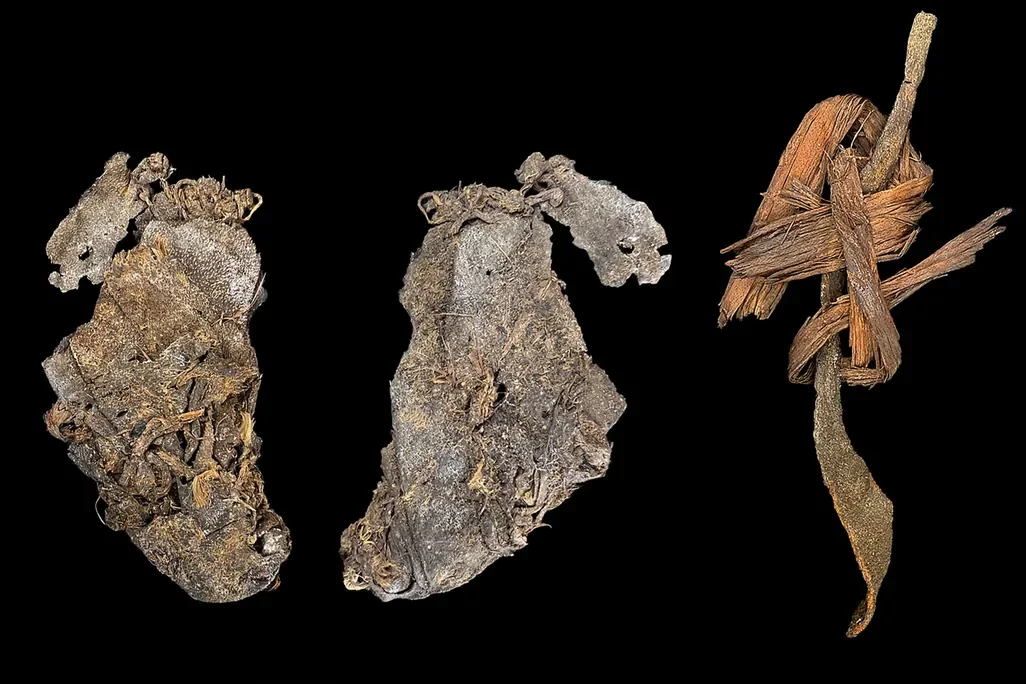
The sewn hide, pictured from the front and the back, alongside another hide artifact from Cougar Mountain Cave Richard L. Rosencrance, et al., Science Advances, 2026
Stone age tanning of leather was a laborious process done with two key ingredients; fat and smoke. After a hide had been removed of hair, flesh, and membrane, it was saturated with fats- the most common being animal brain. Brains contain organic emulsifiers and lecithins. This natural lubricant coats the individual collagen fibers of the hide, preventing them from sticking together and stiffening when the hide dries (like rawhide). Other fats, including egg yolks, fermented milk or butter, marine oils, animal fat, or liver could be substituted or used in addition to animal brains depending on what ecological resources were available. The hide was then physically stretched, pulled, and worked over posts or sewn into tensioned racks. Fat alone is not enough to produce leather however. After the tedious work of softening an oiled hide as it dries, if it were to get wet, the fibers would revert back to their stiff, hardened state. This is where the smoke comes in. The aldehydes in wood smoke, specifically decayed or “punk wood” that burns cooler, penetrate the fibers, chemically cross-linking the proteins and fat, keeping them open, stable, and non-water soluble, forever transforming the skin into leather.
Who were the first people to think of slathering raw animal skin with brains? What serendipity that each animal has a brain just the right size to tan its own skin with.
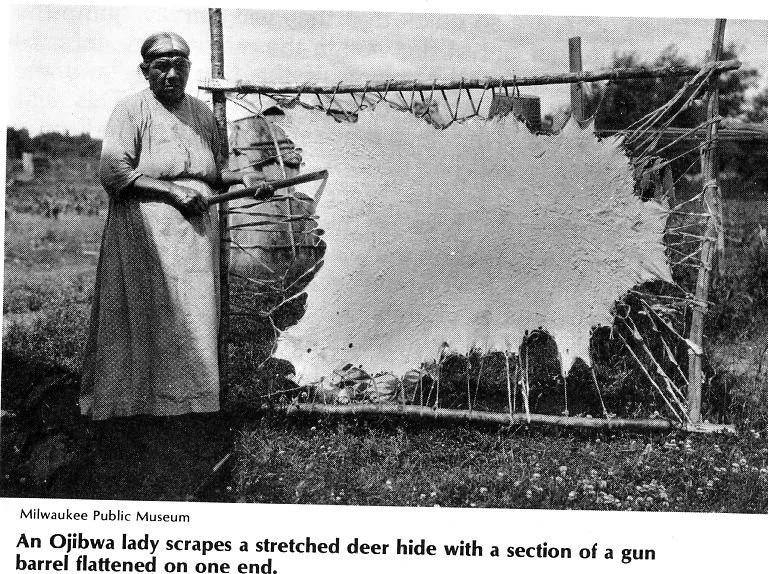
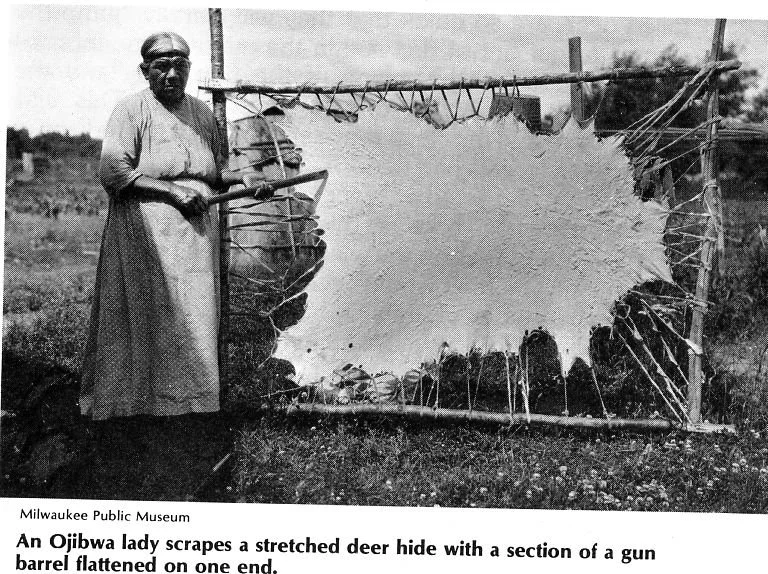
During the stone age this was how leather was made and pelts were tanned. Most of what we know about traditional “brain tan” methods today we owe to the indigenous stewards of Turtle Island, or North America. Despite the attempted extermination of these people and their lifeways, they shared this knowledge and continue to carry their traditions forward. Every human on earth, at some point, has an ancestor that practiced fat and smoke tanning.
What is tanning?The modern word tanning comes from the medieval latin word tannare (to convert animal hide to leather), which is derived from tannum (crushed oak bark). The origin of tannum has Celtic roots, from the Breton word tann or “Oak tree”.
“Tannins” refer to naturally occurring chemicals found in the bark and leaves of plants, like the Oak tree. Tannins are astringent; the drying pucker that happens in your mouth from a cup of black tea or red wine are tannins in action. Tannin rich plants are ancient collaborators when it comes to the production of leather.
This chapter of the story began along the fertile rivers in Egypt, Mesopotamia and the Indus Valley. 5,000 years ago, as humans moved from pastoralism to agrarian culture, highly sophisticated tanneries developed By utilizing tannins found in oak, willow, sumac, acacia and pomegranate, as well as other natural materials like wood ash, lime, and mineral salts, they processed animal hides into leather. It is the tannins in these plants that perform the biochemical transformation of skin to leather, but at a much slower pace than is accomplished in fat and smoke tanning. A hide can take months to tan in a solution of extracted bark, a time frame that was incompatible with nomadic peoples seasonal movement.
Historically, this type of bark tanning was considered a highly skilled craft that was often passed down through families or male dominated guilds. This was different from tanning for our stone age ancestors, where the work was predominantly done by women, not men.The specialized knowledge for preparing and preserving the hides or controlling and manipulating the tanning solution were learned over years of apprenticeship, and the dexterity of the tanners' knowledge dictated the quality of leather they could create. Leather was an essential part of everyday life and was used to craft waterskins, clothing, shoes, armor, shields, boats, saddles, and shelter. Bioregional dye plants created striking colors, while embossment and carving of the leather distinguished different artisans.
Empire building eventually led to the creation of large scale bark tanneries across the Mediterranean and into Europe. The entire Roman army was outfitted in bark tanned leather armor and techniques for producing heavy or lighter leathers were perfected during this time. For the Romans, tanning hides into leather was simply one part of a highly efficient system for processing and using every part of the animal carcass. From meat to bones, nothing was wasted. The logistical scale of leather production was impressive: a single Roman Legion required a minimum of 68,000 goat skins to make tents and more than 3,000 cattle hides annually for boots. Equipping and feeding an army of this size required calculated planning. These were the first types of tanneries to produce at this volume, which continued on into the medieval ages as the demand of leather continued to grow, and the extractive nature of colonization spread.
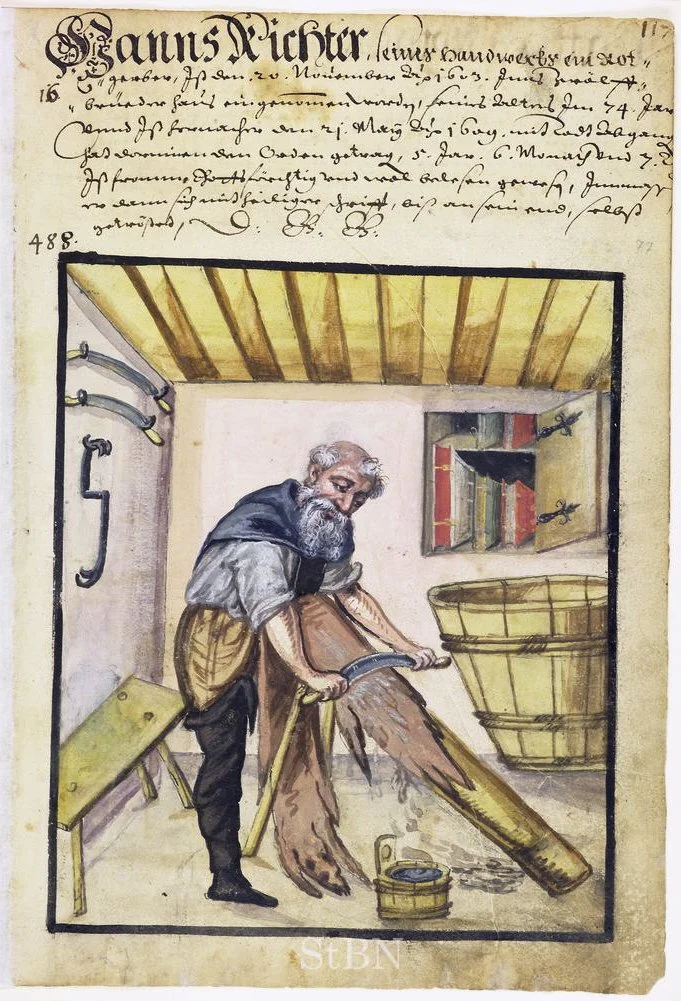
This was in the era of conquest, when the old forests of Europe were aggressively and systematically logged and being intimate relationship with the land was no longer an innate rhythm. The widespread clearing to make way for agriculture decimated woodlands and natural habitats. The erasure of the commons included nobility seizing communal hunting grounds, criminalizing common folk for hunting deer and wild game, severely limiting the access people had to not only food, but leather as a material. The seizure of common lands essentially eliminated the home tanner, as guilds and tanneries became the only source for leather, making the material inaccessible to commoners. This culture of domination and mass extraction, shifted the way humans tanned leather
The archetype of the Tanner has held a culturally contradictory position. Producing leather was economically vital, and the artistry of the craft was highly respected, however the proximity and association with dead animals led to a societal marginalization. By the medieval ages as the demands for leather increased, how tanners processed animals had to be adjusted in scale.
It’s true that historically, medieval tanneries were dirty, smelly, and generally avoided by the public. It is important to keep in mind this was also a time before refrigeration, plumbing, and advancements in modern technology. The towns themselves were often unsanitary due to the absence of sewage and disposal systems, so we can hardly expect a tannery, a place where death was transformed into textile, to be a beacon of cleanliness.
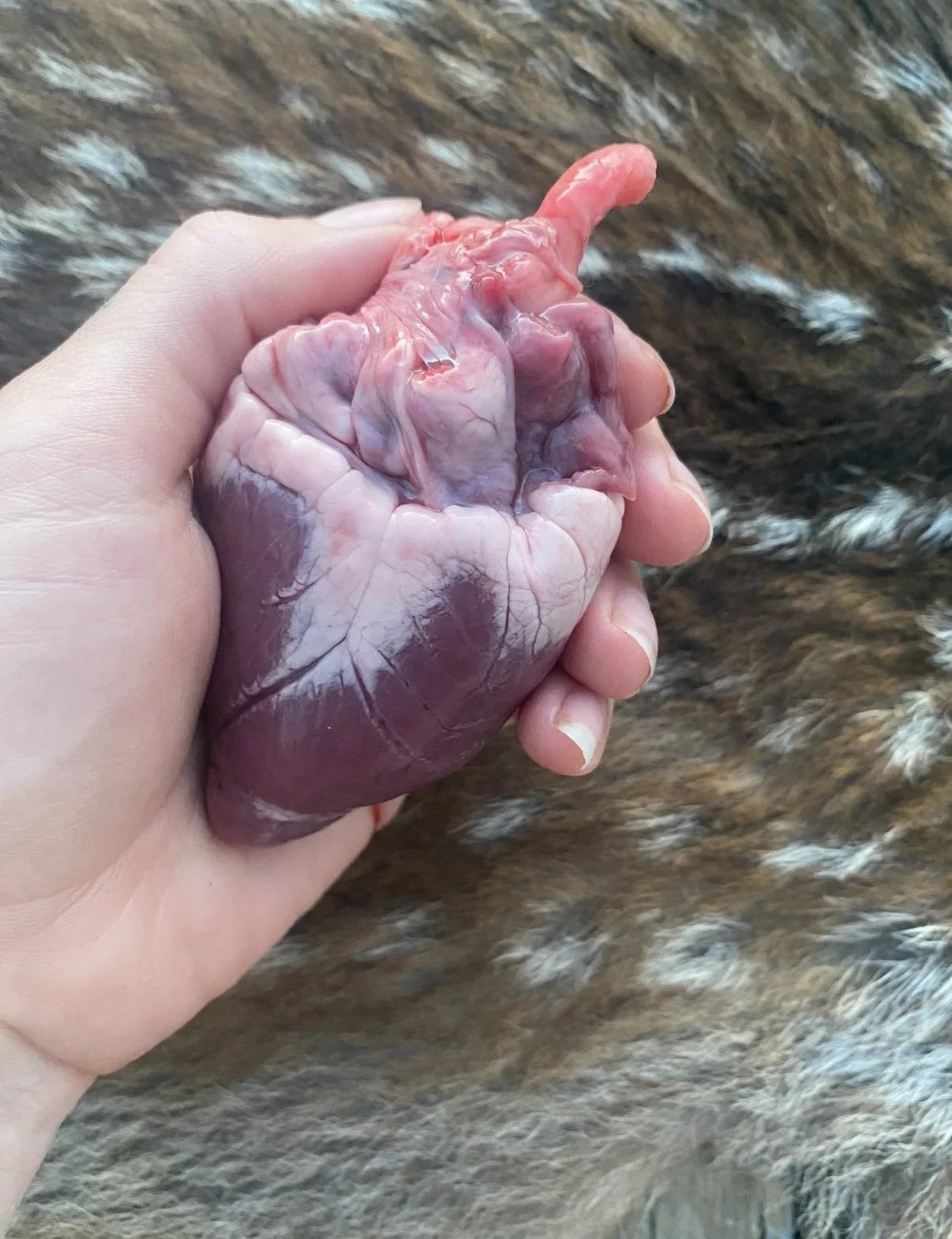
As a tanner in the 21st century, one of the most common questions I receive is about the “smell”. There is such a profound disconnection in our culture from knowing where our food comes from, that most people have never harvested or processed an animal, and thus lack an understanding of what I can only call, the freshness of death. Death, fresh and immediate death, is not the rancid rot of days or weeks old decomposition. The birth of a newborn is bloody and the harvest of an animal is bloody, but the smell of iron and the sanctity of the act is the same in both.
Modern tanning is not deodorized, but it is certainly not the horror stories of the old tannery by the river that have folks imagining the effluvia of maggots and dung more than the earthy perfume of tree barks brewing and the smoky incense of cedar.
I believe the contrast between an industrial tannery and the small-scale tanner is an important one. For our stone age ancestors, tanning a hide was done in community and it was done in scale. These were not stationary farmers, they were pastoralists and nomads, and tanned leather as needed, as they moved, with the materials available to them in that moment. They did not live in a way that allowed for rotting materials, but crafted in a much more dynamic and fluid rhythm that is contrary to modern, industrial tanneries. The loss of ceremony and respect for death, the loss of connection to the land, and the birth of capitalism’s never ending hunger have altered the way we approach a craft that fundamentally is a transformational art, a prayer of metamorphosis for those who wield it.
The final chapter of our story begins in 1858, when German scientist F. Knapp and Swedish chemist Hylten Cavalin discovered a way to tan leather chemically using chromium salts. This revolutionized the industry of tanning and by the 1900’s, tanneries were being run as industrialized chemical factories, prioritizing speed and efficiency despite the severe environmental impact of heavy metal pollution.
Today, chrome tanning accounts for more than 85% of all leather production around the world. Since the 1970s, fewer than a dozen tanneries even exist in the United States, most outsourcing their leather production to China and India. In the poorest and most populous countries, with no labor regulation, more than half of tanneries employ child laborers. These adolescents and women work with no occupational safety standards and are exposed to a toxic slew of chemicals that leave them with dermatitis, melanoma, respiratory illnesses, blindness, leukemia, and cancer. While chromium is the star of the show, the International School of Tanning Technology provides a list of 48 different chemicals that are commonly used in leather processing including formaldehyde, a known carcinogen.
Chrome tanning is a thirsty business. One ton of raw hide needs 50,000 liters of water, and in the average chrome tannery, only about 20 percent of the chemicals used are actually absorbed by the leather, the other 80 percent enter local waterways. The intense influx of heavy metals kills off aquatic life and microorganisms, disrupting delicate ecosystems, and the waste continues to travel up the entire food chain. This contaminated water is used in irrigation, and heavy metals accumulate in the soil, the crops, and livestock. The most notable study was done in Bangladesh where chromium and other toxic materials were found in more than half of all chickens and eggs.
Chrome tanned leather is not biodegradable like bark or fat and smoke tanned leather, which under the right conditions can be composted in as little as one year. If buried, chrome leather will leach toxins into the soil and will remain in landfills for longer than the average human lifetime.
If chromium is so dangerous, why continue with its use? The answer is simple. Under global capitalist systems, time is money. Tanning leather with natural bark extracts takes more time, up to four weeks. Chrome tanning can be done in less than 24 hours.
Through time, capitalism has always sought to mechanize and separate craft from the environments they were birthed into, yet ancestral art resists. Every basket is still woven by two hands. Colonists who came to the so-called New World were taught by native peoples to tan using fat and smoke, creating “buckskin”, a style of tanned deer leather that was once as ubiquitous as a pair of blue jeans. This style of leather has always been done by hand and has to this day never been successfully industrialized.
For time immemorial, this craft has been a bridge between ecology, agriculture, and chemistry in a circular exchange of organic resources.
A vessel holds water. A basket stores food. Textiles clothe our bodies. These crafts may seem mundane but they are part of the deepest and oldest story of what it means to be human, because what it means to be human is to create. To be human is to hold need and desire in a single breath and look at the resources around you through imaginative eyes. Humans needed warmth, gazed upon the rabbit with their soft fur, and imagined something new. Through their relationships with their environments, humans discovered how to halt decay, to manipulate death, and create the oldest textile in the world.